

Home · Industries · For AI-enabled B2B software
Built for the company whose champion does the selling.
Every pilot, renewal, and expansion worked overnight, with the reason attached.
Your deals are decided in meetings you are not in. A champion carries your case down the hall, and what they carry is whatever your team sent last. The follow-up that arms the champion is the work that slips when the quarter gets loud.
What does Midsummer do for an AI-enabled software company? Midsummer works every account overnight: it reads each prospect, pilot, and customer relationship, chooses the next move and says why, and readies the meeting brief, the follow-up note, and the answer in the thread. Anything it does opens in the log with its source, so the team can check the grounding.
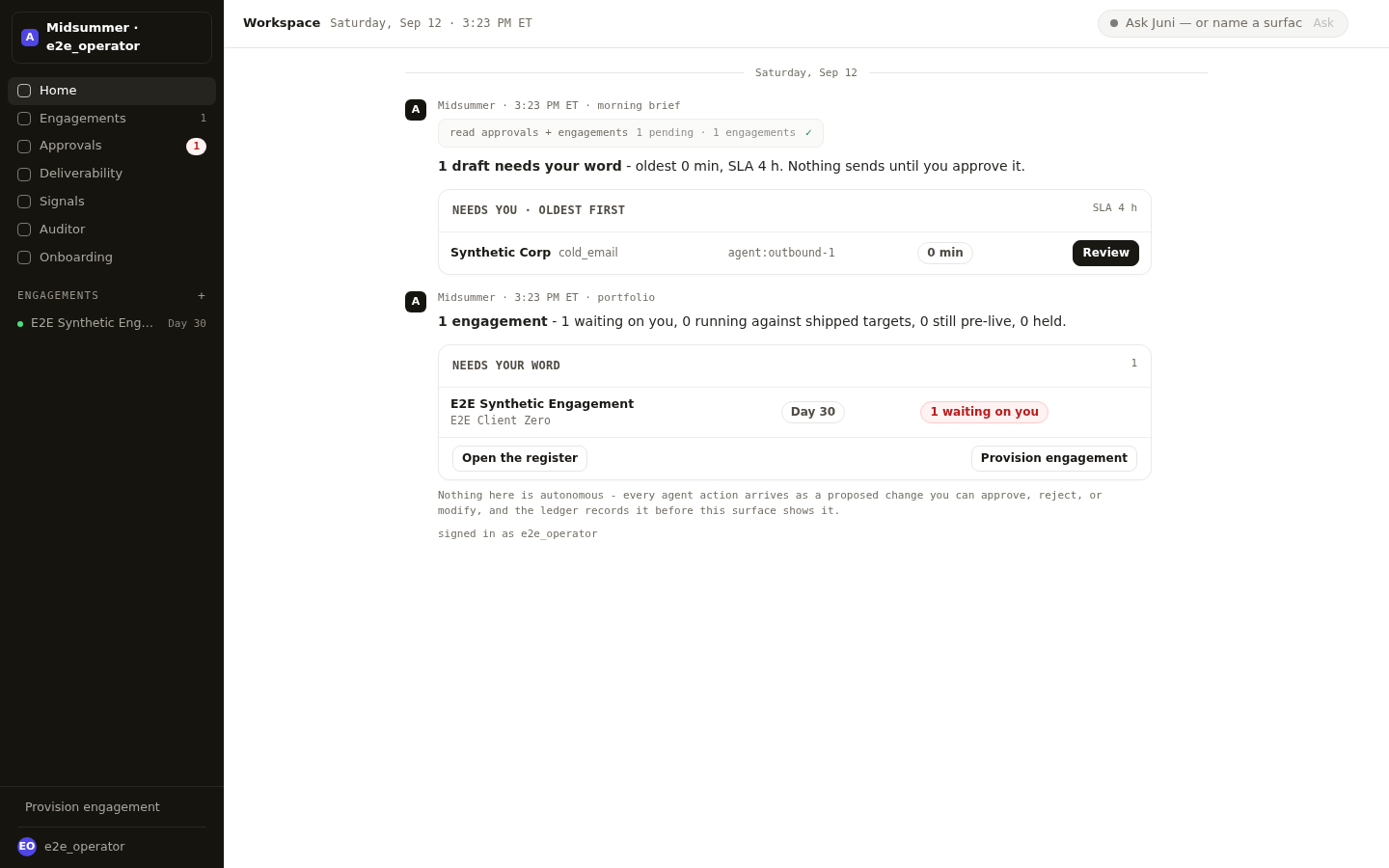
Arm the champion before their internal meeting
Next in the product: Open the brief, then send the note that travels.
The cluster index
Three leaves cover the software matrix
What slips
The champion carries the deal
A software deal lives or dies in rooms your team never enters. The note your champion forwards matters more than the deck your team presented. Midsummer writes each answer from the thread, and a person on your team approves it before it leaves.
How the department works it
Long cycles, worked accounts
Software cycles run quarters, and the gaps between check-ins are where evaluations drift. The department works those accounts nightly and drafts the note that keeps the evaluation moving while your team is heads-down on the roadmap.
The proof
Proof a revenue team can check
The log shows what ran, what it said, and what came back, each with its source. A team that forecasts off its CRM can audit this the same way: open any action and read it.
Questions software teams ask
How does Midsummer learn our accounts?
From your CRM, your inbox, and the materials you already have. It reads what each account has said and done before it writes a word, and keeps the source attached so the grounding is checkable.
Does it work alongside our sales process?
It runs inside it. The department prepares and people send; every action carries its source, so your team can check what was written and why before anything leaves.
What does it take to start?
Read access to CRM and inbox, scoped in writing when you onboard. End the access and the work ends with it. There is nothing to migrate, and nothing new for the team to learn.
Will our prospects know it is involved?
Nothing leaves under any name but yours. The worked history stays open to the team: what ran, what it said, and what came back.
Related
For developer tools companiesFor data and API companiesFor security companiesThe software matrix
Each connector lights up when you grant access.
Send the list of pilots in evaluation and see it worked end to end. Or ask for access; the team writes back.